In each of the lessons, you can click on this top logo to go to the index of lessons
Lesson 7: Circle of Fifths
The Circle of Fifths is a tool for understanding how different keys and chords
relate to each other. As we get further into playing chord progressions and songs in
different keys, the Circle of Fifths will be an important tool.
.
For this lesson I have created an online version of the "Circle of Fifths" tool
that my students used to create by cutting out circles of paper and attaching
them together. Click the "Circle of Fifths" button to make this tool appear - it
will come up in a new window or a new tab on your web browser, so that you can still
look at the lesson. From there you can click on the arrows to rotate the inside
circle clockwise or counterclockwise.
.
In future lessons, when the Circle of Fifths tool will be helpful, I will include
a button to make the tool appear.
.
.
RM200
.
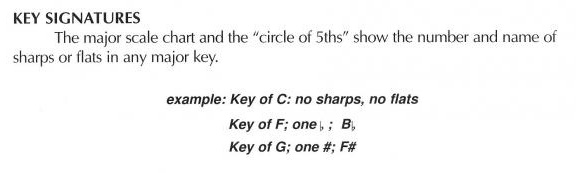
Take a look back at your Major Scale Chart to see how many sharps or flats there are
in various different keys. A key signature appears at the start of a piece of music
to indicate how many flats or sharps there are in the key this music is written in.
If you need to view the completed Major Scale Chart, click
here
.
.
.
RM201
.
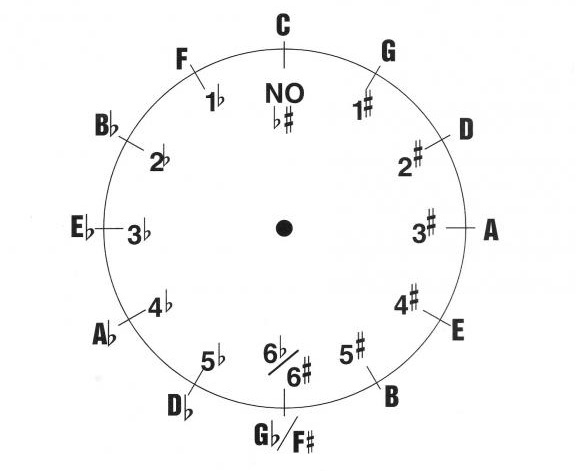
Here is a version of the Circle of Fifths that shows how many sharps or flats
are in each key (the version above didn't have this). If you don't have access
to any printed music, you can click
here
to see a page scanned from an old church hymnal.
.
.
.
RM202
.
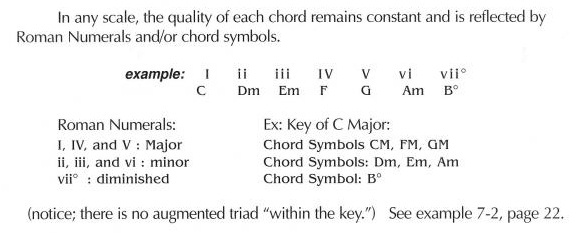
A "diatonic triad" uses only the notes that are in the scale we are playing.
.
.
.
RM203
.
Working in any key, the quality of the diatonic triads will remain constant -
the chord based on the second note of the scale (ii) will always be minor, as will
the iii chord. The IV and V chords will be major, the vi chord minor and the
seventh step will always be diminished.
.
.
.
.
RM204
.
If you want to create a paper copy of the Circle of Fifths, as described in the
narration, you can use
this file.
To use the online version, click on the "Circle
of Fifths" button below.
.
Click here to display the Circle of Fifths tool.
.
.
RM205
.
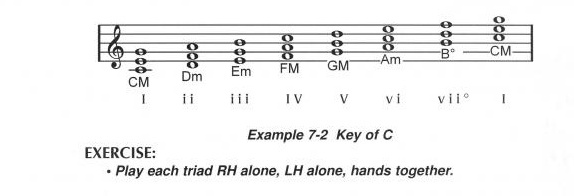
In the key of C, all of the "diatonic triads" we'll be playing will be
all on white keys. Some of them will be "major" chords, some will be
"minor" chords, and one will be a "diminished" chord - but all these chords
will be played on all white keys.
.
.
.
RM206
.
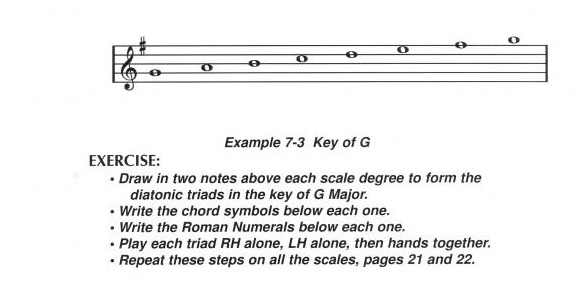
This next set of notes is in the key of G, which means that one of the notes
is played on a black key. Click
here
for a .pdf version of this exercise that
you can print out and complete.
.
.
.
RM207
.
Now that you've had a chance to work through this exercise on your own, let's
try playing it together! Here's a clue: the V chord (D Major) and the VII chord
(B diminished) will have something special in common. When you play those chords,
make sure they sound like the chords I'm playing in the recording!
.
.
RM208
.
Eventually, you want to be able to play these exercises in any key, so that you can
play any song in any key. The worksheet for this lesson (click the "Worksheets" link
below) has blank staves in each scale that you can use to build a major triad
progression.
.
Click this button to view and print a worksheet containing blank staves (that's the
plural of staff, at least in music) that you can use for this final exercise.
Fill in the notes for each major triad scale of notes.
.
Click the "Answers" button to print out a completed set of diatonic triads for
each key. In this "Answers" sheet, notice that we didn't have to mark each
individual sharp or flat note, because the Key Signature takes care of that -
if the note "F" in the key signature contains a "sharp" symbol, then any time
there is an "F" note in the music, it is played as an "F#" (unless the composer
indicates it should be played as a plain "F" note - but that's getting way ahead
of what we're trying to learn in this lesson).
.
When you return to the course index page (click the logo at the top of
this page, you will see that there is a link to a set of Practice exercises
for Lesson 7 (and some other lessons). I encourage you to follow that link
and go through these additional practice exercises to help you learn to
play the major scales on the keyboard.
.
.
Hooray, You Made It Through Lesson 7 !!!
Once again - we covered a lot of material, and I hope it all made sense. The Circle of
Fifths will become an important tool as we move into playing in keys other than our
simple keys of C, F and G. If you have any questions about any of the material in this
lesson, click on the "Ask Rhonda" button to send me an email, and I'll respond as
quickly as I can!

 Lesson 7: Circle of Fifths