In each of the lessons, you can click on this top logo to go to the index of lessons
Lesson 10: Rhythm
There are two aspects of musical beats: pulse (the steady beat) and rhythm (the
length of individual notes). In playing by ear, we need to feel the beat (and
stay with it), but there are many different choices we have with regard to rhythm.
And, once again, while we generally think of "playing by ear" as playing without
musical notation - it's helpful to have at least a sense of what's going on in the
written music - and it will help me explain some of the concepts and exercises
we meet in this lesson.
.
If you decide you would like to view the "Circle of Fifths" tool for this lesson, you
can come here, to the top of the page, at any time and click this button to open it -
again, it will open in a new tab or window.
.
.
RM232
.
Listen to this clip to start learning about concepts of rhythm in music.
.
.
RM233
.
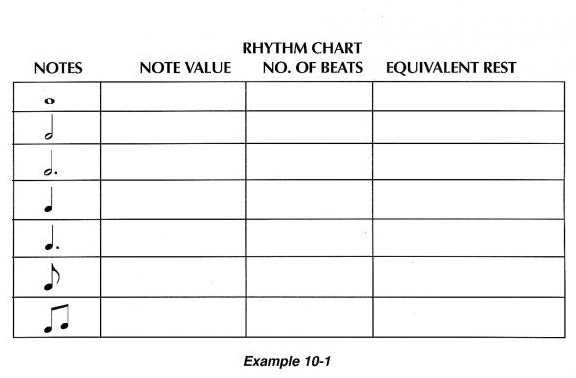
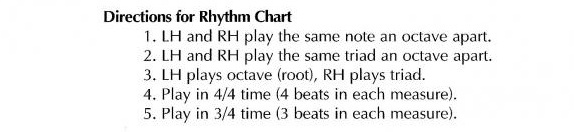
In this section we will be filling out the "Rhythm Chart."
.
Click on the "Worksheets" button to view and print a copy of the Rhythm Chart that you
can fill in as we go along.
.
.
Don't worry about the "rests" for now, we'll get to those eventually.
.
.
.
RM234
.
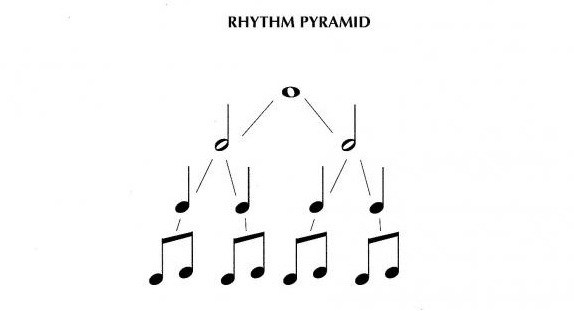
Here is the Rhythm Pyramid - another way of showing the relationship of different notes
to each other. Just listen as I play the different rhythms in the Rhythm Pyramid.
.
.
.
RM236
.
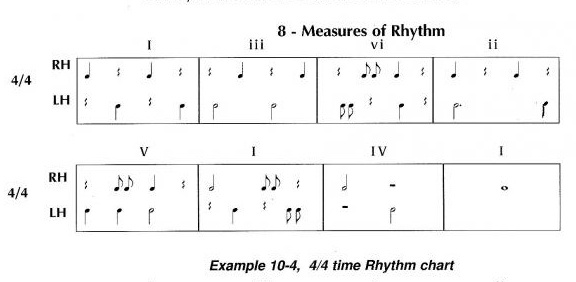
So let's start learning how to play different rhythms:
.
.
.
.
RM237
.
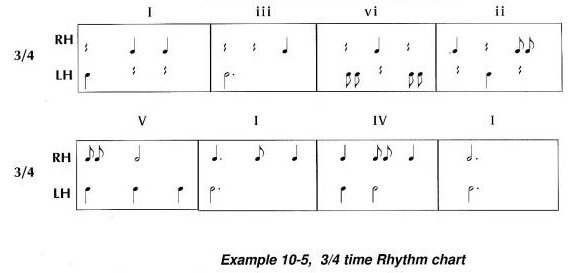
And here's a rhythm chart in 3/4. I'll play an example of the 3/4 rhythm, and I'll
play through our example rhythms.
.
.
.
RM238
.
Play the audio clip to learn about the way musicians count quarter and eighth notes.
We'll start out with our 4/4 rhythm:
.
.
.
RM239
.
And now let's practice counting a 3/4 rhythm:
.
.
.
RM240
.
.
.
(Note that this rule about the meaning of Stem UP and Stem DOWN applies to the
rhythm charts we will be playing in this lesson. However, when you are looking at
regular notated music, the directions of the stems on the music has an entirely
different meaning)
.
.
RM241
.
Now we'll make it a little trickier by changing chords each measure, using these rhythms
with one of our Chord Progressions from the last lesson.
.
.
.
(Note that, when you are playing along with printed music or chord charts, the
chord (or number) will normally appear right above the note or lyric word where the
chord changes. So in the first bar of the example above, the "I" would normally appear
over that FIRST quarter note, not over the third one. If it appears over that third
beat, then you wouldn't change the chord you're playing until the third beat of the
measure.)
.
.
RM242
.
And let's repeat that example using our 3/4 rhythms, C chord throughout:
.
.
.
RM243
.
And now, repeat the exercise where we change chords each measure:
.
.
.
Click on the "Worksheets" button to view and print a worksheet that contains more
3/4 and 4/4 rhythms. You don't need to worry about playing the notes in this
exercise, just use it to practice counting and clapping out the rhythms. If it
helps you to do so, you can write in the counts for each line of music.
.
Of course, if you feel like you're ready to try playing the notes on the piano, that's great -
but for this lesson, we're really just looking at the rhythms.
.
Each line of music is in a different rhythm and key signature. At the end of each
line of music, the rhythm and key signature for the next line is written in - this
is something musicians do so that the player won't be surprised when they look
down to the next line and find things have changed! Musicians can usually look
ahead on the line they're playing, but if they look ahead to the next line of
music and then try to find their place again, it can be confusing. So this is
just a convention used in sheet music to make it a little easier on the musicians
who are playing.
.
RM244
.
For our final exercise, we'll put it all together: print
this page
this page
so that you can create your own rhythms and practice playing them.
.
.
Hooray, You Made It Through Lesson 10 !!!
Rhythms are tricky - and as you will discover when you start playing songs, there
are many, many different rhythms. Part of "playing by ear" is being able to hear
the rhythm of a song and adjust your playing so that it sounds right for the song.
.
I hope everything in this lesson made sense - as always, if you have some
questions at the end of the lesson, click the "Ask Rhonda" button to send me an
email and I'll try to answer your questions as quickly as I can!

 Lesson 10: Rhythm