In each of the lessons, you can click on this top logo to go to the index of lessons
Lesson 5 Practice: Chord Songs
.
In Lesson 5, we learned about "chord songs." We're still just doing one key at a time, but
this is the next step after playing simple scales.
.
If your piano and computer are in different locations, you can click
the "Worksheets" button below to view and print a page that has all
the chord songs on it, so that you can go sit at the piano and
practice.
.
Click "Worksheets" to view and print out all the illustrations you will
need for this lesson. If you are able to view your computer screen
while you're at the keyboard, you won't need to print this out, although
you may want to print it just so you can write in some notes on how to
play the different keys...
.
.
P1T14
.
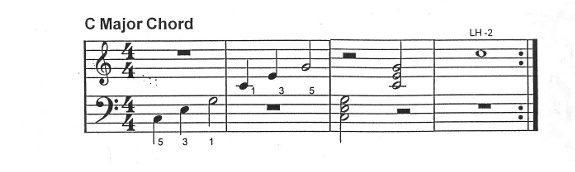
In this first clip, we play the Chord Song in the key of C - our
simplest key, since it has no flats or sharps. Play along with me,
and keep practicing until you can play the Chord Song correctly and
up to speed.
.
.
.
P1T16
.
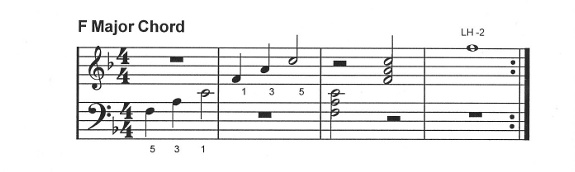
Instead of just going up by half steps, we will be playing the Chord
Songs in the order of the chord "Groups" you learned in Lesson 5 - if
you watched the Musical Snowmen videos, you may remember these as the
"Freezing Cold Guy" chords. In these first three clips, all the notes
you play will be on the white keys (even though the key of F has one
flat and the key of G has one sharp).
.
.
.
P1T17
.
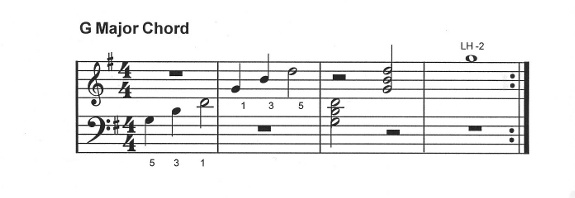
This is our final chord in Group 1 - the G chord. All the notes in this Chord
Song will be on the white keys.
.
.
.
P1T18
.
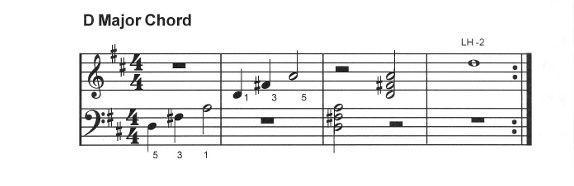
Now we move on to Group 2 - the chords with one black note in the middle.
If you watched the Musical Snowmen, these are the keys where the snowman
was wearing a "sharp sweater" to help keep his "Elbows and Arms Dry."
.
You will notice that the "key signature" for this key contains two sharps
- the first on an "F" note and the other on a "C" note. To make it easy
for you to play this exercise, I've also marked all the "F" notes with a
sharp symbol. In normal printed music, though - if the key signature
tells us that any "F" notes are played as F#, the individual F# notes
will not be marked. Once you're familiar with playing in the different
keys, this is actually easier than you think - and you'll be glad that
the only time you see a sharp or flat in the music (these are called
"accidentals") will be when you're playing a note that is NOT in the
major scale for your key.
.
.
.
P1T19
.
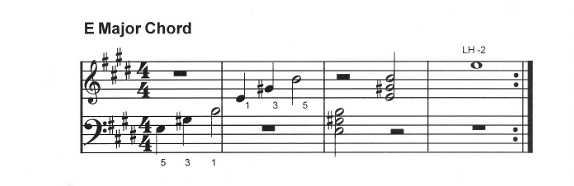
Our next Group 2 Chord Song is in the key of E - four sharps.
.
.
.
P1T20
.
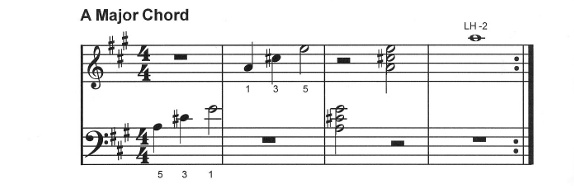
Our next Chord Song is in the key of A - three sharps. Again, I've
marked the notes that are played as sharps in the music, but in regular
printed music, you won't see these marked.
.
By the way - if you worked through the Practice Exercises for Lesson 3,
you may recall that these "sharp keys" - D, E and A - are good keys for
guitar players because they use lots of open strings. So if you expect
to be playing in a rock band or some other kind of group that is mainly
a "guitar" group, be sure you practice these "sharp" keys until you can
play them easily and well!
.
.
.
P1T21
.
Now we move on to Group 3 - the chords with black keys on the top and
bottom and one white key in the middle. The Musical Snowmen videos
talked about this snowman wearing Boots (to keep his "flat feet" warm
and a Hat - to help keep his "Ears and Ankles Dry." Since the bottom
note of each chord is on a black key, these chords will have to be
called either "sharp" or "flat" keys - and it turns out that it's easier
to call these chords "flat" chords - Db, Eb and Ab.
.
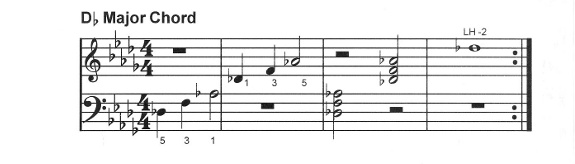
Our first chord is Db, and the key of Db has five flats! It may take a while to get
this Chord Song right, but keep practicing until you have it!
.
.
.
P1T22
.
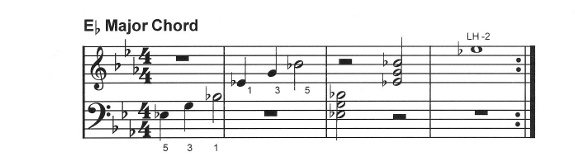
Our next Chord Song is in the key of Eb - three flats. If you worked
through the Practice Exercises for Lesson 3, you may recall that Eb is
a really easy key for saxophone players - for them, playing in Eb is
like playing in C for a piano player. So if you're going to be
playing jazz, or some other music style that uses a lot of horns, be
sure you practice these "flat keys" until you can play them easily!
.
.
.
P1T23
.
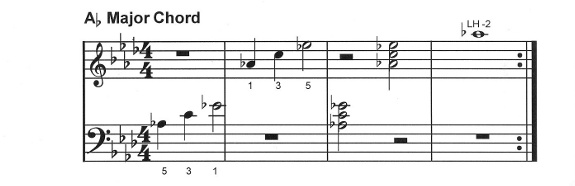
And our final Group 3 Practice Exercise is for the key of Ab - four flats.
.
By the way - if you find that you're having a hard time remembering
what keys are in what group, and you didn't look at the Musical Snowmen
video, you might want to go back to Lesson 4 and watch. (It uses Flash
animation, so you may need to find a computer that lets you watch
Flash - a lot of mobile devices don't). In the Musical Snowmen, we give
you a bunch of ways to help remember the keys in each group and the
names of the chords.
.
.
.
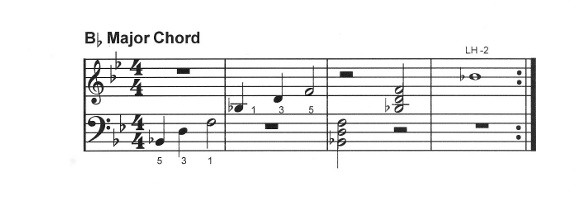
And now we get into our final group - the "oddball" chords. And... as
always seems to happen when dealing with oddballs... we goofed! We don't
have a recording of a practice session in the key of Bb, the first of
our "oddball" chords. But here is the notated music for the key of Bb,
and by now you should know how the Chord Songs go well enough that you
can play this one on your own. Notice that there are two flats in this
chord - the Bb chord has a black key at the bottom (since the name of
the chord includes "flat," we know it has to start on a black key) and
then two white keys above that.
.
Bb is another good "horn" key - for trumpets and a lot of other horns,
Bb is the easiest key to play. So if you expect to be playing with
horn players a lot, be sure you learn the key of Bb extra well!
.
.
.
P1T24
.
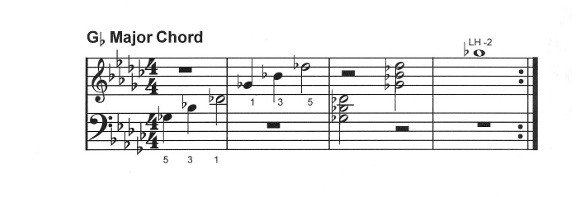
Our next "oddball" Chord Song is in the key of Gb - six flats! Remember
when we were doing the Major Scale charts and the Triad charts - by the
time we get up to six flats, we start having notes like Cb, even though
there is not a black key just below the C note! So work on this one and
see if you can get through. If it's any consolation, Gb is not an easy
key for guitar players or horn players - so you won't have to play in
Gb very often.
.
As you may recall, the scales in Gb and F# are all the same notes,
they're just called different things... we have not included an F#
chord song here.
.
.
.
P1T25
.
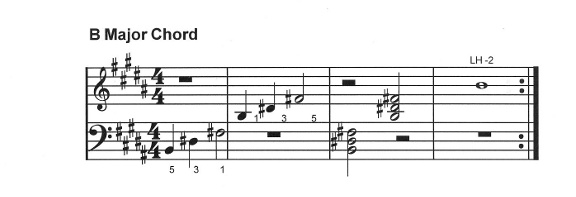
And our final "oddball" Chord Song is in the key of B - five sharps!
Because the name of the B chord does not have a "flat" or "sharp" with
it, you know that it must start on a white key, but because there
are so many sharps in the key signature, you know that most of the
notes in this key, and in this Chord Song, are going to be on the
black notes. Like Gb / F#, the key of B is fairly unusual, but try
to work through the exercise, because every now and then you will run
into a song in "B".
.
.
.
Hooray, You Made It Through Lesson 5 Practice!!!
I hope that playing the Chord Songs has helped you expand your
knowledge from just playing scales - we're starting to get to the
place where it's sounding like music! As always, if you have any
questions, or if you find any problems with the lesson, please
click the "Ask Rhonda" button to send me an email. If you have a
question, I'll try to answer as quickly as I can!

 Lesson 5 Practice: Chord Songs