In each of the lessons, you can click on this top logo to go to the index of lessons
Lesson 4: Triads
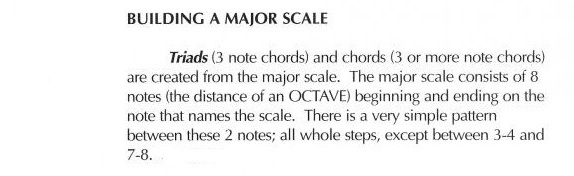
We first learned about triads in Lesson 3 when we were learning about the Major
Scales; the definition of a Triad is included below. If you need a correctly
completed "Major Scale Chart," you can click on the "Worksheets" link below to
view a .pdf copy that you can print out.
.
Click this button to view and print a correctly completed "Major Scale Chart." You
should have completed this chart during lesson 3, but if you don't have it with you,
this will provide you with a complete, correct copy to use during lesson 4.
.
.
RM153
.
Play this audio clip for an introduction to the idea of Triads.
.
.
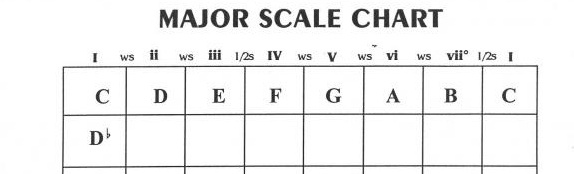
Click this "Worksheets" link at the top of the lesson to view a .pdf copy of the
correctly filled out Major Scale chart, if you don't have your own filled out copy
available. You will definitely need a copy of this chart available as you work
through this lesson! It will show up in a new tab or window, so you may need to
look for it. The header section of the Major Scale chart looks like this:
.
.
.
RM154
.
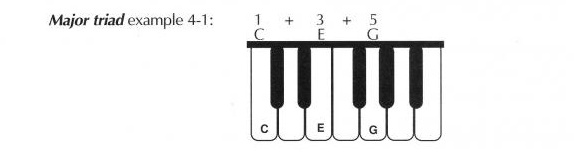
Example 4-1 shows the C Major triad. Play along with me as I play this triad:
.
.
.
RM155
.
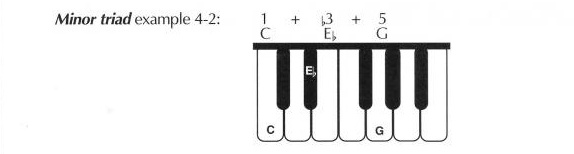
Example 4-2 shows the C Minor triad. Play along with me as I play this triad:
.
.
.
RM156
.
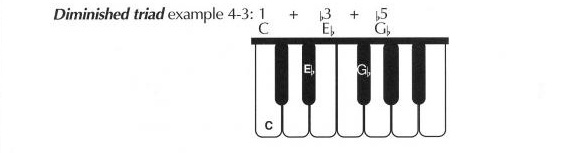
xample 4-3 shows the C Diminished triad. Play along with me as I play this triad:
.
.
.
RM157
.
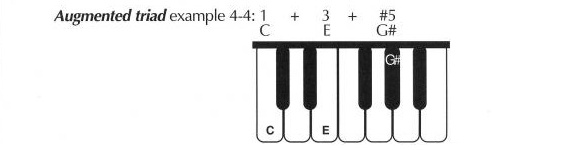
Example 4-4 shows the C Augmented triad. Play along with me as I play this triad.
.
.
.
RM158
.
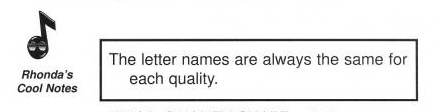
Let's review those four triad qualities. Remember, for each of the "C" triads,
one note will always be a "C", one will be an "E" and one will be a "G". Sometimes
the note will be a sharp or a flat, but the letter names will always be the same
for all four qualities.
.
.
.
RM159
.
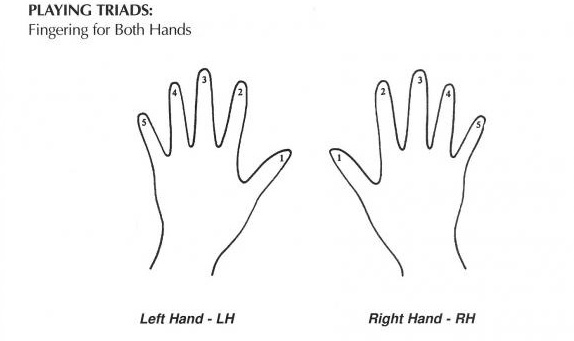
Let's take a look at our two hands. Play the audio to learn about how the left and right
hands work together to play music.
.
.
.
RM160
.
On the keyboard, your left hand pinkie finger and your right hand thumb will
both be on "C" notes.
.
.
.
RM161
.
Play along with me as we use both hands at once to create some harmony. Remember,
when you are playing the thumbs (the "1" fingers), the left thumb will be playing a
"G" note, but the right thumb will be playing a "C" note. So it will sound more
interesting than just playing two of the same notes. Take a look at the diagrams
for the last two clips if this isn't clear.
.
.
RM162
.
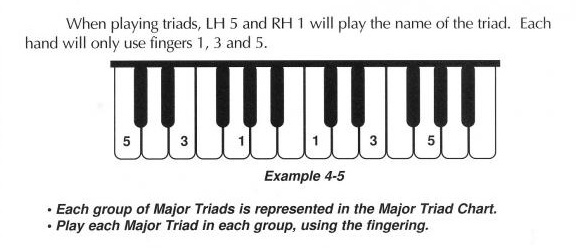
In example 4-5, both hands are playing the notes of C Major triad - so in addition
to using them to play individual notes, we can also play the triads with both hands.
I'll show you the picture again so you don't have to look back up the screen:
.
.
.
RM164
.
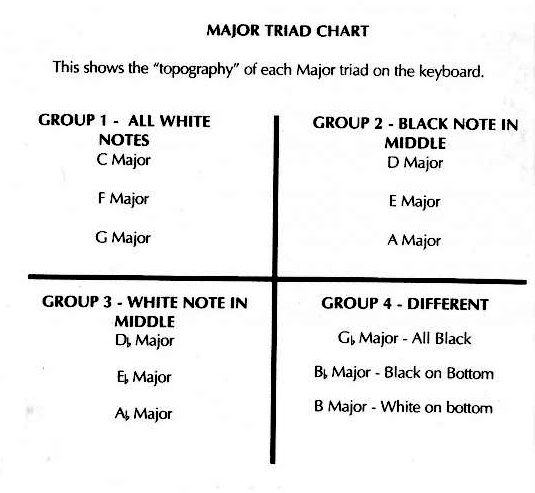
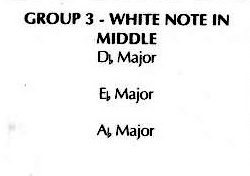
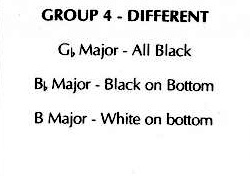
Just as the C Major triad has a distinct look on the keyboard - all white keys -
ALL the major triads have a "topography" about them. There are only 12 major triads,
and they break into four groups of three, based on how they are laid out on the
keyboard.
.
.
.
RM165
.
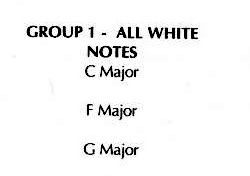
Click here to learn about Group 1 - chords that are played on all white keys.
.
.
.
RM166
.
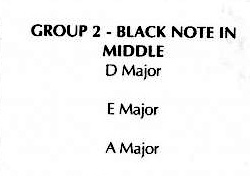
Click here to learn about Group 2 - chords that are played on two white keys with one
black key in the middle.
.
.
.
RM167
.
Click here to learn about Group 3 - chords that are played on two black keys, with
one white key in the middle.
.
.
.
RM168
.
Click here to learn about Group 4 - chords our "oddball" chords.
.
.
.
The Musical Snowmen
If this idea of four groups of chords is still confusing you, you might enjoy
meeting "The Musical Snowmen." This is a video that a friend put together for me that
teaches about the groups of chords using a bunch of "snowmen" to help you learn and
remember the different groups of chords.
.
Click the "Help Me Out" button to meet The Musical Snowmen! Note that this video
does use flash animation, so you may not be able to watch it on some mobile devices or
computers that do not have the flash player installed... sorry.
.
.
.
RM169
.
On your Major Triad chart, you'll see that all 12 major triads are
represented, in groups of four.
.
.
.
RM170
.
For practice, we're going to play a fun little pattern for each chord. I'll show
you the pattern in our teaching key, "C". For practice, try to play this same pattern
for EACH of the major triads. Play this clip, and I'll teach you the pattern in "C".
.
.
.
Hooray, You Made It Through Lesson 4 !!!
Congratulations on finishing another long, long lesson. As always - I hope everything
made sense, but if you still have questions, click on the "Ask Rhonda" button to send
me an email, and I will get back to you as soon as I can!

 Lesson 4: Triads